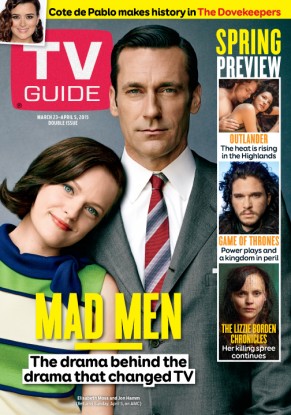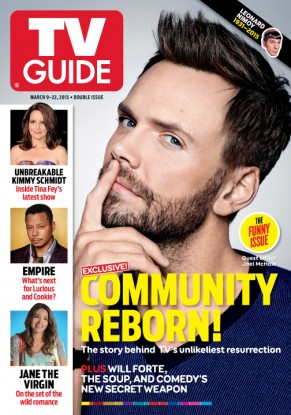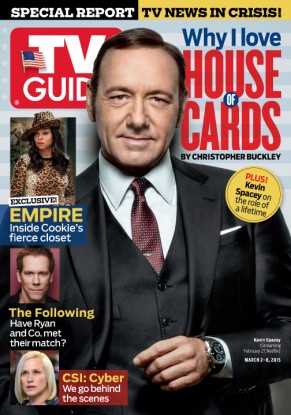
On newsstands March 5, 2015

Community Reborn! How Yahoo Saved Greendale

It’s an early January afternoon, and the cast of Community has gathered on the show’s cafeteria set to meet the woman who saved Greendale Community College.

This is the first time that Kathy Savitt, chief marketing officer and head of media at Yahoo, is sitting down with star Joel McHale and Co., and she has a lot to share. Savitt details Yahoo’s plans for the show: Community trailers in movie theaters, a pricey Emmy campaign, a premiere party at Austin’s South by Southwest festival, an active presence on Tumblr (the blogging platform that Yahoo owns), and more.

Ten minutes into her spiel, Savitt realizes she’s not getting much of a reaction. She pauses. She’s thinking, Does that all sound OK?

Ken Jeong, who plays eccentric student/school employee Ben Chang, finally pipes up: “No one’s ever talked to us this way!”

A few weeks later, back on set, Jeong says he’s still stunned by the show’s reversal of fortune. “I’m not used to the kind of love we’re getting this year,” he says. “It’s been so surreal and sublime to be in a position where we all saw the ax coming, and then a few months later to be able to tell Kathy, ‘We want this.’”

One of the most unconventional series ever to hit primetime, Community always struggled for acceptance at NBC, where it debuted in 2009. Initially pitched as a comedy about strangers who bond in a community-college study group, the show quickly became an experiment in deconstructing the sitcom form. Created by iconoclast Dan Harmon, Community earned critical acclaim and a loyal (if small) fan base by parodying TV tropes and making meta jokes about pop culture.

Viewers fell in love with the show’s quirky characters, but by Season 3, executives from NBC and Sony Pictures Television, the studio behind the show, felt it wasn’t commercial enough to garner mainstream success and had grown tired of clashing with Harmon. Harmon was fired, and new executive producers were brought in.

Ironically, the new showrunners essentially tried to emulate Harmon’s Community blueprint, and the show failed to broaden its base. McHale lobbied hard to bring back Harmon and fellow executive producer Chris McKenna, and in an extraordinary move, the two were rehired. But by the end of Season 5, it was clear that NBC had had enough of Community’s shenanigans. Even though the show averaged a 1.5 rating among adults 18–49, a decent number nowadays, the network was ready to cut it loose. “If you look at our ratings, they were pretty darn good,” McHale says. “But it was always, ‘Well, you’d be lucky to get picked up.’ We were [in flux] until they eventually canceled us. That was a great day. Fun day. That’s sarcasm, folks.”

Alison Brie, who plays bright-eyed student Annie Edison, says it was tough to schedule her career around a show that was forever on the bubble, unclear whether it’d be renewed or canceled. “It sucks,” she says. “Every year we would be on hiatus, it was stressful trying to do other work. But the show always came back.”

Until it didn’t. After NBC canceled Community last May, Sony attempted to set it up at Crackle (the streaming site it owns) or Hulu (which holds the series’ syndication rights). Neither deal worked out, and it looked as though the doors to Community might get locked for good. “We all moved on,” says McHale, whose Jeff Winger, a lawyer turned student, led the charge to save Greendale last season when Subway tried to turn it into a university devoted to sandwich making. “There was a long period between cancellation and Yahoo buying it. We all started conversations with other networks [about other shows]. It’s not like my kid’s finger got chopped off or someone died. But artistically, it was a real bummer.”

Gillian Jacobs, who plays misinformed psychology major Britta Perry, says she was told by many that the show was dead and never coming back. “I started to move on,” she says, “because otherwise you’re just a Miss Havisham character, holding on.”

To mark the end, the cast gathered last June at a Los Angeles restaurant for a goodbye meal. “We had planned the
dinner and thought, ‘It’s either going to be a celebration or a wake,’” McHale says. Danny Pudi, who plays the socially awkward Abed Nadir, says the gathering ended up being a bit mournful: “We all got drunk, cried a little bit, laughed a lot.”

But Sony Pictures Television doesn’t give up easily. The company recently resurrected Unforgettable at A&E after the show had been dropped by CBS—just the latest in a long line of programs it has revived elsewhere. “People perceive there’s so much animosity between Dan Harmon and us,” studio president Steve Mosko says. “Sometimes business is like sports, where there’s a lot of back and forth. But one thing we all have in common is we want the show to continue. How we get there is sometimes a little bumpy, but that’s the way it works.”

Harmon says he’s figured out how to work with the studio and was thrilled that, in an email leaked during the recent Sony hacking case, someone at the company praised the show. “Sony is a gigantic corporation that is good at certain things that others are not—like keeping shows alive,” he says. “Even when deep down they loathe the people who created the shows, they pump it with formaldehyde; they defibrillate it.”

But Harmon had also made peace with NBC’s decision. He was ready to return if Hulu was attached (“They bought my house,” he says, alluding to the syndication dollars), but he was skeptical of Yahoo’s interest. “I immediately said, ‘No way, that’s ridiculous,’” he says. “I had never heard the word Yahoo in association with television before.” His opinion changed when Savitt called and he couldn’t detect a hidden agenda. “There was no way I could say no to this person,” he says. “I would have spent the rest of my life wondering, ‘What if I had joined forces with her?’ She might have a moon colony at some point. If I do a good enough show, maybe we get extra oxygen.”

For Yahoo, Community is the first offering in a new slate of original programming: Bridesmaids director Paul Feig is behind Other Space, a comedy about misfit space travelers, while Smallville’s Mike Tollin is executive producing Sin City Saints, a comedy about a Las Vegas basketball team. The plan is part of a larger strategy for its free Yahoo Screen streaming service. The company, which produces video content for its digital magazines covering food, finance, travel, and other topics, also has a deal with Live Nation to air live concerts every day. “Community is a great opportunity for viewers who come for one show to sample our others,” Savitt says. Season 6 launches on March 17 with two episodes; additional installments will be rolled out one per week. Yahoo’s deal for a 13-episode season will even allow for shows longer than the broadcast-standard 21½ minutes. “They can breathe a bit,” McHale says.

The pact was signed just hours before the stars’ contractual obligations were set to expire. “I was kept in the loop by Sony, but that’s because I would badger them,” McHale says. “We were all asked, ‘If this thing happened, do you guys want to do it?’” Once Harmon was on board, he had to convince his fellow executive producer to return. “It was time to move on,” McKenna says of the cancellation. “I told Dan I have a newborn, I just got hired to write a feature, and Universal wants me to develop a pilot. But Dan promised to be my Lamaze coach. It’s all I needed to hear.”

Savitt is making good on her promises so far. McHale marvels at the attention, which includes Community’s first large-scale promo shoot since its debut season. “We knew it was different right then,” he says, “because they were already spending money, and they were giddy.”

The cast members agree they won’t miss waking up on Friday mornings to see the ratings. Like Netflix and Amazon, Yahoo has no plans to reveal how many people are watching—at least initially. “You may find that we had more viewers than previously counted, because I think the Nielsen system is heavily stacked against a show like Community,” Jacobs says. “Kids watching us in their dorm rooms at 2am may now for the first time be counted.” McHale’s expectations are a tad higher: “I think it’s going to be [streamed], like, a billion times.”

The freedom Yahoo offers may be too much for Harmon and McKenna. Without NBC’s standards and practices deciding what’s appropriate, the showrunners are policing themselves to make sure themes don’t become too adult. As for language, Harmon admits to “loosening the corset.” Some network-banned words will now make it onto Community, including Jesus as an exclamation. “I always found it odd that people couldn’t utter that word,” Harmon says. “It’s so primal and not profane.”

***

Community didn’t just move to Yahoo. It physically relocated to the San Fernando Valley after NBC’s Marry Me took over its space at the Paramount lot in Hollywood. The show’s new facilities, in a former parking garage at the CBS Studio Center, are much larger than the old digs, which has allowed the producers to build additional sets, including a pub. But it’s been hard on the actors, who have had to learn a different Greendale floor plan. “Just a week ago, I realized there was a much quicker path to Annie and Abed’s apartment,” Brie says. “Danny still gets lost every day. He has to have someone holding his hand to bring him to set.”

Community’s space is so big, Harmon has started tooling around on a Segway. “What surprises you anymore?” Pudi says, laughing. “Dan Harmon rides the Segway around the cafeteria, because he can!”

The show is also stretching beyond the stage, filming more outdoors—including a trip back to Los Angeles City College, where the pilot was filmed. “We’ve seen natural light for the first time in four years,” Brie says. “We can go shoot on a street that looks like a street!”

For viewers, the departure of two cast members (following Chevy Chase and Donald Glover’s earlier exits) may be Season 6’s most jarring change: Yvette Nicole Brown (sweet Shirley Bennett, the show’s moral center) left to care for her ailing father and has gone on to The Odd Couple, and Jonathan Banks (crusty professor Buzz Hickey) joined Better Call Saul.

Paget Brewster and Keith David are two of Season 6’s new additions. Brewster (who guest starred as a different character last season) plays Frankie Dart, a problem solver who shows up in the premiere to put Greendale’s finances in order. “She might be a metaphor for Yahoo,” Harmon admits, “in the sense that she’s an unprecedentedly professional presence in this asylum.”

But Frankie’s plans don’t sit well with some of the gang. “I start cutting things that the students and Jeff want to keep, and it upsets Jeff,” Brewster says. “They discover that, without Shirley, there’s a lack of a voice of reason. They’re crazed animals. Frankie’s good at what she does but ends up having to be a jerk to do her job.”

David is introduced in the second episode as Elroy Patashnik, a washed-up inventor who comes to Greendale in search of redemption. “I’m the guy who did all the wonderful ideas that didn’t pan out,” David says. “I feel I understand something about being a dinosaur.”

Jim Rash (flamboyant Dean Craig Pelton) and Nat Faxon directed the episode, which also finds the dean stuck in one of Elroy’s virtual-reality contraptions. “That was nerve-racking,” Rash says of his first time helming a Community episode. “Even though you’re in a very safe environment, it’s still Dan’s words and the writers’ vision. The actors couldn’t have been nicer—although,” he adds with a laugh, “Joel is a little hard to direct.”

***

It’s a rare rainy February afternoon in Los Angeles, which fits the mood inside the Community writers’ room. The staff is struggling to map out a story about Chang leaving Greendale behind after becoming a minor national celebrity. Abed had been making a film featuring Chang, and after realizing they can use that footage to capitalize on his fame, the other study-group members conjure up a plan to turn the footage into a new movie, leading Abed to lose control of the project. But the writers can’t figure out what’s motivating Abed to play along.

Harmon pitches idea after idea. Just like Abed, who traffics in pop-culture minutiae, he peppers every example with a reference, citing, in the course of an hour, Ed Wood, Brewster’s Millions, Bob and Doug McKenzie, Major League, Rocky Balboa running up the steps in Philadelphia, and Fonzie. “Breaking stories gets harder each year,” he says, noting the difficulty in keeping characters “this familiar going through experiences that challenge them every week.” He decides to sleep on it and cracks the idea the next day. The episode is probably the most ambitious in a season that is mostly back to basics. “We have been doing a season that is very much a sitcom set in a community college,” Harmon says. “It’s character-driven.”

On set a week later, it’s clear the episode is also a comment on Community itself, as Abed and Jeff candidly discuss their fear of being left standing alone as everyone around them departs. “Jeff is in a crisis this year,” McHale says. “He’s got some big questions about this school and losing people in this life. He’s brought these people in, and now what is going to happen? He’s dealing with how he’s opened his heart, and he might experience loss.”

This season’s guest stars will include Steve Guttenberg and Billy Zane, and some familiar faces may even be back. Harmon is coy when asked about Chase’s claim that he was invited to make an appearance as the (now deceased) curmudgeon Pierce Hawthorne: “All I’ll say is, if Chevy was approached about doing a cameo for Season 6 and he did spill it on Reddit, then he deserves everyone accusing him of being insane.” The possible return of Glover (who played jock Troy Barnes and left to pursue a music career) is a more sensitive subject. “That’s too painful,” Harmon says. “I just want him to come back. I’ll talk to him on the phone about life and stuff, but I don’t want to be the guy he stops calling, so I don’t push it.”

At this point, after the ups and downs, the producers and stars joke that the show will never leave them—they will have to leave Community. But the actors’ six-year deals are up after this year, and if there’s a seventh season, it’s likely that several more of them will depart. Among the busy troupe, Jacobs is starring in Judd Apatow’s Netflix series Love; Jeong has the semiautobiographical comedy pilot Dr. Ken set up at ABC; Pudi will return to NBC for the horror-comedy pilot Strange Calls; and Rash, who won an Oscar with Faxon in 2012 for the script of The Descendants, is writing and directing more features.

Harmon has two ways of looking at it. “One,” he says, “is we have been pared down to the absolute minimum. If Alison is unavailable for an extra hour a week, our show deflates like a balloon. The other way is the show itself is about people in transition. Is there such a thing as a bad version of Community if the entire cast leaves and we audition new people and do some strange Law & Order spinoff using the same sets and sensibility?”

Hopefully, fans won’t have to find out. McHale, who still hosts the weekly pop-culture clip show The Soup on E! and is developing shows, says he’s game to continue. “We are a fungus that is very hard to remove,” he says. Jeong agrees: “I can’t quit the show. I still have more to learn, more to evolve. If all I had to do was Community for the rest of my life, that would be heavenly.”

That will be up to Yahoo. “We will be transparent with our advertising partners and share numbers at some point,” Savitt says. Yahoo will also look at how Community performs in social media and whether it drives users to other Yahoo content.

If Community does go on, Harmon says he won’t ever be able to leave: “After being the guy who wasn’t supposed to have a show, the guy whose show was supposed to be canceled, the guy who got fired from his own show, and then the guy who got rehired, I’m the only thing that can go wrong. I can’t be a rebel anymore. I’m going to be the last one here.”

ALSO IN THIS ISSUE:
  • Guest editor Joel McHale interviews The Last Man on Earth‘s Will Forte
  • How The Soup gets made: A behind-the-scenes tour of E!’s snark tank
  • Scoop on Empire, Bates Motel, The 100, Jane the Virgin, and more!
  • Paying tribute to Leonard Nimoy
On newsstands February 26, 2015

The Winning Hand of Netflix’s House of Cards

People who’ve worked at the White House have a special gift. They can turn themselves into the biggest bores in the room by announcing to their fellow viewers of The West Wing or Scandal or House of Cards that what has just happened is (a) absurd; (b) ridiculous; (c) implausible; or (d) absurdly, ridiculously implausible.

To which the only appropriate response is: Will you please shut up?

I worked at the White House for two years in the 1980s, as a speechwriter to Vice President George H.W. Bush. So I possess this “special gift”—in spades. My wife is so fed up with my nitpicking that she no longer says “please.” In fact, she no longer says “shut up.” She just hits me. Who could blame her?

Politics can be—this will come as a shock, so brace yourself—a grubby business. But grubby business makes for splendid entertainment. After I left the White House, I wrote a bunch of satirical novels about politics and Washington, D.C. One, Thank You for Smoking, about a tobacco lobbyist, was made into a movie. In retrospect, these books may seem to pluck low-hanging fruit. It’s not that hard to make fun of politicians. They manage to do that all on their own.

But politics can also be—bigger shock coming, strap yourself in tightly—dull. So it’s no surprise that novelists, screenwriters, and TV scenarists often find themselves amping things up a mite.

My wife and I recently watched the first six episodes of Season 3 of Netflix’s House of Cards. And you know—she didn’t have to punch me once. Which isn’t to say that the series has suddenly taken a turn for the realistic. Far from it. But the fact that I’m able to watch it without grumbling tells me that I have achieved some sort of Zen-like satori, or enlightenment. It’s liberating, really. Go ahead, jump the shark. The bigger the shark, the higher the jump.

It would be churlish to give away too much, but I must mention one detail from an early episode: A Russian president who is the spitting, minatory image of Vladimir “the Terrible” Putin comes to D.C. for a state visit. And whom does he have sitting at his table at the White House state dinner? Pussy Riot.

You remember Pussy Riot—the Russian female punk-rock group, some of whose members were thrown in jail for daring to question Czar Putin’s idea of democracy? In an inspired bit of casting, two members of Pussy Riot play themselves. The premise behind this seating arrangement is that President “Petrov” has actually requested to have Pussy Riot at the table. And even to have a photo op with them, so the serfs back in Russia will think him broad-minded (as it were). Hmmm. Let us pause to ask ourselves: How likely is this? The point of having Petrov come to Washington, by the way, is to get his cooperation in a Middle East peace initiative.

But wait! I’m having another moment of satori! Now I get it: The real implausibility is the whole concept of peace in the Middle East! That sound you hear is my one hand, applauding House of Cards.

The episode is dramatic as can be, and wonderfully satisfying, even as it pirouettes from one oh, puh-leeze implausibility to the next. The subsequent episode centers on a reciprocal visit by President Francis Underwood and First Lady Claire. Its conclusion will leave you gobsmacked, as they might say in the original British version of House of Cards—muttering to yourself “Whoa!,” even as your Inner Implausibility Meter is going, “Weeooweeoo!” like an amok carbon dioxide detector.

The president and first lady are—of course—played by the unimprovable Kevin Spacey and Robin Wright. Spacey is without equal as a villain. We met him in Season 1 as a South Carolina congressman, and by the end of Season 2, he had connived and murdered his way to the presidency of the United States. (Is this a great country or what?)

Spacey’s Underwood may be the role of his lifetime, but Spacey is still young (55), so this prediction seems, happily, unlikely. His performance is nothing short of mesmerizing. You find yourself cheering him on, even as he sinks to bathyspheric lows. Here is Faust, eatin’ ribs.

And why is it that Southerners seem to make the most entertainingly venal politicians in political dramas? Remember Sen. Seabright “Seab” Cooley from the 1962 film of Allen Drury’s Advise & Consent? He was played to rumpled, seersucker perfection by Charles Laughton. Most famously, there was Willie Stark in Robert Penn Warren’s masterpiece All the King’s Men, based on Louisiana Gov. Huey P. Long. Broderick Crawford portrayed him in the 1949 film with hearty, convincing menace—and very human vulnerability. We loved these guys even as we raised our eyebrows and murmured, “Oh, dear!”

I don’t know the answer. Maybe it’s the zest these good ol’ boy scoundrels bring to their roles. They just seem to revel in their wickedness. Yankee politicians at least take the trouble to look guilty.

The original British House of Cards, from 1990, was notable for breaking the fourth wall: The lead character turns and addresses the viewer directly, with the other players unable to hear what he’s telling us. It created an intimacy between us and Ian Richardson’s chilling Francis Urquhart. Urquhart was a silkier villain than Spacey’s earthy (if slick) Underwood. When he spoke to us, it felt as though we were being addressed by Mephistopheles himself.

The elimination of the fourth wall in the American House of Cards makes the intimacy all the more intense. The very first scene in Season 1 begins with Underwood addressing us as he strangles to death a mortally wounded dog on the sidewalk. This takes “You had me at hello” to a whole new level. Right away, we—and poor Toto—understand we are a very long way from Kansas.

Spacey once told an interviewer, “I think people just like me evil for some reason. They want me to be a son of a bitch.” Before he began shooting Season 1, he was on stage at the Old Vic in London in the title role of Richard III. House of Cards executive producer David Fincher told Spacey that would be “great training” for playing Francis Underwood. Yep, I’ll bet it was.

Spacey won a Best Actor Oscar for his performance as a middle-aged husband and father who develops a sexual obsession for a teenage girl in 1999’s American Beauty. But he’s essentially a good man who is redeemed in the end by paying a terrible price. There’s a core of decency inside Underwood, but the way things are going, by the time House of Cards folds its final hand, we’re going to need an MRI to find it.

I relish Spacey most when he’s playing an SOB: the vicious movie studio boss in Swimming With Sharks; sadistic office manager in Glengarry Glen Ross; small-time con artist Verbal Kint in The Usual Suspects; and killer antiques dealer Jim Williams in Midnight in the Garden of Good and Evil, where his Southern accent was more bourbon than Underwood’s barbecue.

What all of Spacey’s bad boys have in common is self-knowledge: They know they’re naughty (and worse) but haven’t a qualm in the world. It’s an essential element in any tragic hero: He knows. I can’t imagine any of Spacey’s villains summoning a priest on their deathbeds. Voltaire, no bad guy, was asked to renounce the Devil on his. He’s said to have replied, “This is no time to be making enemies.” So might Francis Underwood remark as he prepares to depart this vale of tears. He’d probably use saltier language.

It is impossible to sufficiently gush over Robin Wright’s performance as President Underwood’s better half—and yes, I am being sardonic. Here is Lady Macbeth, wearing Prada. Actually, I don’t know if it’s Prada, but whatever she’s wearing, Ms. Wright is a stunner in every scene. (President Petrov sure thinks so!) She evinces the malign sexuality of a dominatrix. You wouldn’t be surprised if she showed up at that state dinner for the Russkies in black latex. And she’d look fabulous.

Weirdly, this marriage between an American Richard III and Lady Macbeth manages to be—touching. Francis and Claire have been together for more than 20 years. They may stray a bit, but they’re devoted to each other. I suppose two Gila monsters could also be “devoted to each other.” But this is one political marriage that works.

Of course, it’s much more than just a marriage. Their vows must have consisted of “Scratch my back, I’ll scratch yours.” I won’t dwell on the fact that House of Cards’ showrunner and principal writer, Beau Willimon, worked on Hillary Clinton’s 2000 Senate campaign as well as campaigns for New York Sen. Charles Schumer and former Vermont Gov. Howard Dean. I wonder: Do his three former employers trumpet their connection with Mr. Willimon? Do they draw attention to it, now that he’s famous for making Machiavelli look like Captain Kangaroo?

Michael Dobbs wrote the novel that inspired the British House of Cards. He had been an adviser to Margaret Thatcher before she was prime minister and, later, was the Conservative Party chief of staff. It was not a warm and fuzzy experience, and it came to an unhappy end. Dobbs and his wife flew to the Mediterranean to chill out. He forgot to pack a book, so he grabbed a paperback off the shelf at Heathrow Airport.

He found it to be complete trash and complained to his wife. She said, “Then why don’t you write one yourself?” He got out a legal pad. By the time the trip was over, the pad contained all of two letters: F and U. When I heard him tell the story, Dobbs hinted that this might have been an unconscious coded message to his wife, from whom he shortly separated. But it was also the initials of Francis Urquhart, the amoral Conservative parliamentary whip. When Urquhart crossed the Atlantic, he became the Democratic whip in the House of Representatives.

As every American television viewer knows, many of our best shows originate in England. When Norman Lear’s fine memoir, Even This I Get to Experience, was recently published, we were reminded that even Archie Bunker of All in the Family had his roots in a British TV comedy called Till Death Us Do Part.

Not all British TV travels across the pond. It’s hard to imagine an American Downton Abbey. But political machination and skullduggery are universal themes. How lucky we are Mr. Dobbs (now Lord Dobbs, if you please) forgot to pack his copy of Middlemarch or Little Dorrit when he bolted for Heathrow that day. How luckier still we are that his accidental novel has been so brilliantly adapted in the U.S.

It’s interesting that the original Urquhart was Conservative. Perhaps the most implausible aspect of all about the American House of Cards is that its hero (as it were) is a…Democrat. I say this as a jaundiced consumer of political TV drama who has sat through one too many shows in which the bad guys are inevitably Republican—villainous versions of It’s a Wonderful Life’s Mr. Potter who chortle and cackle as they gleefully cut welfare benefits to the poor; despoil the environment; reverse Roe v. Wade; enable felons and lunatics to purchase machine guns; and gut financial regulation even as they hustle campaign contributions from Gordon Gekko and the Wolf of Wall Street.

President Underwood, may I say, sir—you are my kind of Democrat.

ALSO IN THIS ISSUE:
  • On the case with CSI: Cyber, the latest edition of CBS’s crime-solving franchise
  • A new direction—and a new threat—on Season 3 of The Following
  • Style secrets of Empire‘s fabulous Cookie Lyon
  • Shameless‘s Mickey and Ian, TV’s wildest (and sweetest!) couple
On Newsstands February 12, 2015

Graphic Content: How Comic Books Took Over TV

No on seems more surprised by the success of The Walking Dead than Robert Kirkman. The creator of the top-rated show, which returned from hiatus on February 8, as well as the writer of the Image Comics series on which it’s based, had watched as his zombie-apocalypse saga was optioned, and ultimately passed over, by a slew of broadcast and cable networks, beginning with NBC in 2005. Kirkman thought he understood the networks’ reticence. “Zombies are essentially people who eat people, so it’s a cannibal show,” he says. “I was like, ‘I can’t foresee a cannibal show on television.’”

That wasn’t the only problem. Comics were doing big business on movie screens in 2005 (Marvel’s X-Men and Spider-Man franchises were well-established box-office juggernauts, and DC would reboot Batman with director Christopher Nolan to great critical and commercial success), but TV execs still viewed them with skepticism. Superman, Batman, and the Hulk had had successful live-action TV iterations between the 1950s and the 1980s, but by the mid-2000s, the only long-running series with comic book roots was Smallville, a hit for The WB (and later The CW) that chronicled Superman’s early years as Clark Kent. For networks, comics were seen as niche. “Historically,” says Kirkman, “everyone who adapted comics had the notion, ‘We have to make this more appealing to a wide audience’ or ‘We have to get rid of some of the silly elements.’”

So when The Walking Dead finally landed at AMC, where it debuted—in all its gory, twisted glory—in 2010, its success would ultimately play an integral part in opening TV to the vast comic book universe. Today, there are six other live-action shows based on comics: The CW’s Arrow and The Flash, ABC’s Marvel’s Agents of S.H.I.E.L.D. and Marvel’s Agent Carter, NBC’s Constantine, and Fox’s Gotham, centering on Batman ally Jim Gordon. And at least five others are slated to premiere in 2015, including The CW’s iZombie, PlayStation’s Powers, and Netflix’s Marvel’s Daredevil, with a dozen or so in development.

Kirkman—who is adapting Outcast, one of his comics from his Skybound imprint at Image, for Cinemax, as well as executive producing Syfy’s Clone, based on David Schulner’s Skybound/Image comic, and developing a Walking Dead offshoot tentatively titled Cobalt—says attitudes have undergone a sea change in the last few years. TV executives no longer think they “know better when adapting a comic book,” he says. “There’s a reverence and respect for the medium showing through in these adaptations. That’s one of the things leading to their success.”

For a long time, even film studios regularly fumbled comic book adaptations. Although several small-press titles like The Crow, Spawn, and The Mask became successful movies, during the ’80s and ’90s, DC Comics had a hit-and-miss record with marquee superheroes Superman and Batman, and Marvel showed little interest in bringing its characters to the big screen, as evidenced by its licensing of Captain America for a 1990 straight-to-video clunker and Fantastic Four to B-movie kingpin Roger Corman for a 1994 film that was never even released. Steven DeKnight, who was a writer and producer for Smallville and is the showrunner for Daredevil, traces the roots of TV’s current comics craze to a moment in 1996. “The huge cosmic shift came when Marvel started their own studios,” he says. “Now they weren’t going to a third party that was translating the material. You had people who actually knew the canon and respected the work.”

According to David S. Goyer, a writer and exec producer on Constantine (based on Vertigo/DC’s Hellblazer) who has worked on several movie adaptations, including The Dark Knight and Blade trilogies, Man of Steel, and the upcoming Batman v Superman: Dawn of Justice, the move from film to TV was inevitable once it proved profitable. “The TV industry saw what was happening in features and thought, ‘Why not try to replicate that success?’” says Goyer, who’s also developing the Syfy series Krypton, focusing on Superman’s grandfather.

Arrow, based on DC’s Green Arrow, was the first comics adaptation to break through on TV post–Walking Dead. When the show premiered in 2012, The CW was still smarting from the loss of Smallville, which finished a 10-season run the year before. “When Smallville ended, The CW lost a lot of men 18 to 34, and men in general,” says network president Mark Pedowitz. “We realized we needed to do something to bring them back. Arrow was the first real attempt.” The story of billionaire rake Oliver Queen’s transformation into a vigilante quickly found an audience, and two years later came The Flash, a spinoff that’s now The CW’s most watched series. The shows “brought men back,” says Pedowitz. “It broadened our audience, which made us more interesting to our affiliates and to many advertisers.”

There’s an element of corporate synergy to the current wave: DC, which publishes Green Arrow and The Flash, shares a parent company, Time Warner, with The CW; Marvel, which puts out the comics in which Agent Carter and the Agents of S.H.I.E.L.D. feature, is owned by Disney, as is ABC, which broadcasts both shows. Still, that wouldn’t make much difference if not for significant technological advances. “We’ve gotten to a very sophisticated place in terms of visual effects,” says Jeph Loeb, Marvel’s head of TV. “You’re able to produce the kind of quality people expect not just for the budget you have but also the amount of time you have.” This is reflected not only in making more stuff explode, explains Agent Carter coshowrunner Tara Butters, but in subtle ways too: “In the pilot, when Howard Stark gets in the boat and starts motoring off, [1940s] Manhattan in the background is a visual effect. We couldn’t have done that even five years ago. The cost would’ve been astronomical.”

These developments are all the more powerful because viewers today are spoiled for choice. “At any given moment, when you’re flicking around channels at home, Thor is on, Man of Steel is on, so you’re competing against those movies too,” says Andrew Kreisberg, a TV and comics writer who was cocreator and co–executive producer of Arrow before undertaking the same work on The Flash. “If you’re not delivering the spectacle you see in a feature, it’s always going to feel less than.”

While the movies began exploiting comics’ potential nearly a decade before TV did, the latter is perhaps a more natural fit for the medium. Pedowitz calls comics “gigantic serialized soaps. You have a treasure trove of material and the ability to look at the characters and what makes them tick.” Comics also offer ready-made storyboards. “Comics are a very low-cost way to explore new concepts, just like novels,” says The Walking Dead’s Kirkman. “But they have a leg up on novels because you can see more clearly how they’d translate.”

Balancing a fidelity to the source material with the creative license to veer from it is a delicate dance. Walking Dead star Andrew Lincoln sees this struggle as one of the defining dynamics of his show. “It’s an eternal wrestling match between the extremities of the comic and making this other thing,” he says. “I think tonally, and possibly emotionally, they try to walk the same path. But direct replicas, facsimiles, trying to be too faithful, that doesn’t work.” For any show, getting the mix wrong can have immediate, and often withering, consequences. Comic book fans tend to be, as Goyer puts it, “disproportionately vocal on the Internet. Bad buzz can really impact what the larger audience thinks, so it’s important to not stray too far from the core concepts.”

On The Walking Dead, some of the comic’s panels find their way into the show itself. Michael Cudlitz, who plays ex–military man Abraham Ford in the series, says showrunner Scott Gimple frequently references images from the comic. “Me and Rosita having sex in the store, and Eugene’s looking through the bookcase—that visual is lifted directly from a [panel],” he explains, referring to a scene from the first half of the current season. Matt Ryan, who plays the title role in Constantine, says reading Hellblazer was a revelation: “With comic books, you have the character’s inner voice written in the panels, so it’s very helpful in terms of getting inside his head.”

Taking in the broad swath of comic book shows either on air or in the pipeline reveals a notable focus on second-tier characters and comics. A recent deal will bring to Netflix four Marvel shows featuring what Loeb calls “street-level heroes”—Daredevil, A.K.A. Jessica Jones, Luke Cage, and Iron Fist—as well as a miniseries based on The Defenders. “What makes those characters unique is if the Avengers are here to save the universe, [these four] are here to save the neighborhood,” he says. In part, this “street-level” focus is just business. “If a character is being exploited in a big way in features, they’re not going to exploit the same character simultaneously on TV,” says Kreisberg. In other words, Marvel is not about to let audiences get their fill of a live-action Spider-Man on a weekly basis, thus endangering his ability to pull $800 million the next time he hits theaters. That said, a Flash feature scheduled for 2018 and Fox’s potential X-Men TV series suggest comics have become such a gold mine that caution may be thrown to the wind.

Nonetheless, on TV, second-tier characters also free up producers from the expectations that come with iconic superheroes and allow them to tell stories that feel more relatable. “In order to do a Batman TV show that will appeal to a mainstream audience, you have to focus on real characters like Jim Gordon,” says Kirkman. “Comics that focus more on who the people are and why they’re doing what they’re doing—as opposed to what they’re actually doing—are more tailor-made for TV.”

Not surprisingly, a hit TV show does wonders for comic book sales. Kirkman estimates that he moves 10 times as many copies as he did before The Walking Dead aired, but he tries not to let this success affect his creative choices. Although Daryl Dixon, who has never appeared in the comic, has, in the hands of actor Norman Reedus, become arguably the most popular character on the show, Kirkman has resisted the temptation to put him in the book. “I try to block all that stuff out and stay the course, because the existence of the comic is what led to all of these things,” he says. “If I allow these things to change what the comic was originally supposed to be, then I’ll feel like I failed.”

With so many comic books on TV or headed that way, how much is too much? Viewership remains strong for Gotham, Arrow, and The Flash, but second-season ratings for Agents of S.H.I.E.L.D. were down slightly from the first, the early returns for Agent Carter have been so-so, and, after a strong start, Constantine has struggled. Are audiences burning out? “That’s like saying there’s a danger of burnout from people adapting novels,” Kirkman says. “Certainly there’s a danger of burnout on superheroes specifically, but there’s a wealth of non-superhero material that’s able to be adapted into television very easily, and people are starting to wake up to that.” In addition to Kirkman’s Outcast, which chronicles a man possessed by a demon, and iZombie, about a medical student with a taste for brains (premiering March 17 on The CW), others in the pipeline include the political parable DMZ, the Western/crime drama Scalped, and Preacher, the story of a reverend with supernatural powers on a literal hunt for God, which Seth Rogen and Evan Goldberg are developing for AMC. Add to that DC’s Supergirl, Static Shock, and Titans projects, and it seems like TV is doubling down on comics.

“Honestly, I think this trend could be here to stay,” Kirkman says. “Comics are idea-generating machines, and once that starts going, it doesn’t stop.”

ALSO IN THIS ISSUE:
  • Survivor: Our exclusive behind-the-scenes oral history at the reality competition that changed the game
  • Previewing the season finales of How to Get Away With Murder and Sleepy Hollow
  • Once Upon a Time returns with Disney’s Queens of Darkness
  • The series finales of Parks and Recreation, The Mentalist, and Two and a Half Men
On newsstands January 29, 2015

Blue Bloods Star Tom Selleck is the Shy, Not Retiring Type

Unlike Frank Reagan, the stern NYPD police commissioner he plays on his CBS hit Blue Bloods, the off-duty Tom Selleck likes to smile, flashing the deep-dish dimples that have won over audiences for more than four decades.

Dressed like the California rancher he is in a tan corduroy vest and casual blue-striped shirt and jeans, the grandfather of six (from stepson Kevin) talks easily and openly over scrambled eggs and bacon in the restaurant of an elegant Upper East Side apartment hotel where he lives while shooting the series. The voluble Selleck is happy to discuss his long career, talk a little politics, and to reveal that—though he may not seem it—he’s been shy his entire life.

First, happy birthday! Do you mind if we reveal that you are turning 70 on January 29?
No. Everybody’s talking about it. It’s no big to me. I probably won’t even do a celebration. My wife, Jillie, won’t throw a surprise party, but I’ll be working and I’m sure my TV family will have a cake for me.

Mark Harmon recently said that he doesn’t spend one second thinking about his appearance. Do you?
I do. I like to think it’s in the context of the work. Clark Gable used to say [acting] isn’t a normal occupation for a man. I tend to think that. I don’t primp. I haven’t had anything fixed. Except my hip. I played a lot of sports, and I got a new hip during the last hiatus.

Congratulations are also due for Blue Bloods’ ratings. You’re averaging 13.6 million viewers. Not bad for a show in its fifth season.
Last week, we were the No. 1 scripted show at 10pm on any night. I get a little frustrated that it doesn’t seem to register with people what we accomplish on Friday nights.

You’ve complained that CBS doesn’t promote the show enough.
They don’t. I think CBS is very happy with our performance, but sometimes they forget about us. Nonetheless, people find us.

After five years are you still enjoying playing Frank?
I’m not bored at all. He’s a fascinating character and a very difficult acting challenge. A good commander can’t show anxiety, worry, or weakness when he’s in front of his people. The challenge as an actor is how do I let the audience know how concerned Frank is about the people he leads, while playing a character who has to put on a command face.

Off the set, you are warm and informal, but on screen you seem to really inhabit the commanding presence of New York’s top cop.
Thank you. There were a couple of early scripts when I would be barking out orders: “Send eight cars there! Do this! Do that!” I said to the producers, “I don’t have to prove I’m the boss. I am the boss, or you wouldn’t have hired me.” I can play that serious gravitas, but I’m happy that when [executive producer] Kevin Wade came in, he gave Frank some humor.

You know Bill Bratton, New York City’s current police commissioner. Do you learn anything from him?
I do. Bratton had a lot of influence on me. I read his book Turnaround, about his first time on the job, under Rudy Giuliani. Though they were on the same page philosophically, there was a lot of conflict between the mayor and his police commissioner.

How close to reality do you want the show to be, considering the strife that is going on now with the New York cops, Mayor Bill de Blasio, and Bratton.
It’s lazy and inappropriate to rip things from the headlines. There’s stuff on the show that seems very timely, but really was developed months before. We’ve shown conflict between Frank and Mayor Poole [David Ramsey] for three years. When we do handle difficult storylines, we feel a responsibility to show both sides in a dramatic way. Not balance for balance’s sake, but because it makes Frank stronger if you don’t dumb down his opponents.

What do cops say to you when they see you on the street?
The actors, writers, and producers don’t want to make NYPD officers perfect, but I know that a lot of cops think we are presenting a three-dimensional picture of who they are in life. All cops have to salute the police commissioner, and sometimes I get a salute! That’s a big deal.

You were 35 when you won fame playing the irrepressible private eye Thomas Magnum. What were you doing before that?
Six unsold pilots.

Weren’t you a model for a while, and even a Marlboro Man?
I did a Salem billboard for about 500 bucks and forever since I’ve been called the Marlboro Man. I did commercials and maybe four still-photography jobs to pay the rent. But in those days, being known as a male model didn’t help your career.

So you weren’t discovered for your looks at a soda fountain like Lana Turner?
[Laughs] Actually a casting director saw me on The Dating Game, where I was hopelessly inept.

What were you doing on The Dating Game?
All my fraternity brothers at the University of Southern California were going on with their girlfriends. Shame on them, they would rig it and pretend they didn’t know each other. I was hopeless. I was very shy.

You were good-looking and an athlete—on the baseball and basketball teams!
All through high school and college, if I fancied someone I had to be fixed up and double-date.

Those women must have kicked themselves later that they didn’t choose you.
Well, I got a good agent from doing the show who helped me get an audition for a 20th Century Fox new-talent program. I was in business school planning a career with United Airlines, and I’d never done any acting! I did a horrible scene from Barefoot in the Park, but I was lucky because [20th president] Dick Zanuck was a huge UCLA basketball fan and he asked me if I knew Kareem Abdul-Jabbar [then known as Lew Alcindor]. When I told him that I played against Kareem [in USC–UCLA games], that’s probably why I got the job. It was a blessing, because I never got a grade higher than a C in my major. When I asked my dad whether I should take the chance to quit United Airlines and take the Fox training and earn $35 a week, he told me, “I don’t think you want to be 35 years old and look back and say, ‘What if?’ ” He really embraced risk. [Selleck’s eyes tear up.] Sorry, I get emotional. There’s a bit of my father in Frank Reagan.

What other risks have you taken professionally?
A lot of people told me not to do [the 1997 film] In & Out because I was playing a closeted gay television reporter, and a tabloid had said I was gay just a few years earlier. I said, “I’ve been trying to do an ensemble comedy forever, and this is one of the best ensembles I’ve ever seen.” Because I had sued several tabloids for falsely saying I was gay, people were saying I was anti-gay. Playing the role ended both those rumors.

How did you wind up playing Courteney Cox’s boyfriend Richard on Friends?
I had just come off three big-grossing movies, and I got professional advice saying, “If you do this, they’ll say you’re crawling back to TV.” I had an edge on the role because I had screen-tested with Courteney and I knew we’d have chemistry.

Is there any project you really regret doing?
There’s only one movie I say ill things about. I was offered [1992’s] Christopher Columbus: The Discovery, with Marlon Brando, who in my generation was the Man. I said I’d only do it if Brando was in it. But when I got on set, instead of seven scenes with Brando, there was only one and he didn’t speak. I tried to quit, but I was warned I’d be sued. It was a horrible movie! Gene Siskel reviewed my hair. I realized that wanting to act with someone, even Brando, was a bad reason to take a role.

On the other hand, you nearly did Raiders of the Lost Ark, right?
There’s a myth that I turned it down. Steven Spielberg and George Lucas wanted me to do it and held out the offer for a month, but I had the Magnum, P.I. pilot and CBS wouldn’t let me do both.

You and your second wife, Jillie Mack, have been married for 27 years. How did you meet?
I was filming Lassiter in London. I went to see Cats because my friend Brian Blessed was in it, and I was fascinated by this person who looked pretty good in her leotard and whiskers. People in the show told her the guy from Magnum was staring at her and she said, “What’s that?” When I called her, I hemmed and hawed so long, she finally asked, “Would you like to take me out for a cocktail?”

Does your daughter with Jillie, Hannah, want to be an actress?
No, thank God. I’m very proud of her. She’s an equestrian, and wants to ride in the Olympics.

You’ve said that you were sometimes put in a box politically, especially after you appeared at the Republican convention in 1984 and worked with the NRA.
And my commercial for [right-leaning magazine] National Review, which didn’t help. I don’t mind saying I certainly lean toward being a conservative civil libertarian, but I have given money to Democrats and I served on the board of the [bipartisan] Josephson Institute of Ethics for 20 years.

How do you feel about actors speaking out about their political beliefs?
I believe strongly that you don’t use your access to the media to blow your political horn when you’re on someone else’s nickel. I would defy anybody who watched Rosie O’Donnell ambush me on her talk show [attacking my support for the NRA] to tell me what movie I was promoting.

Jesse Stone, your last TV movie franchise, did pretty well. Could it be revived?
Pretty well? The last movie had almost 15 million viewers! There’s a lot of interest out there in the business about doing more, probably not on CBS.

CBS owns the rights doesn’t it?
Yes, but I have permission to take it elsewhere. Cable’s the place for it. Cable is a little more grown up. Jesse’s very adult.

It doesn’t sound like you’re ready to retire to the ranch any time soon.
Not any time soon.

Blue Bloods airs Fridays, 10/9c, CBS.

ALSO IN THIS ISSUE:
  • Sneak peek at the Breaking Bad prequel Better Call Saul
  • Gabrielle Union previews Being Mary Jane‘s crazy second season
  • Get to know Ioan Gruffudd, the drop-dead sexy star of Forever
  • Plus: The Walking Dead, Chicago Fire, Empire, NCIS: Los Angeles, How to Get Away With Murder, and more